






What Does Scrum Mean?
Scrum is an Agile management framework based on iterative and incremental progress, utilized in complex product development processes. As a subset of the Agile methodology, Scrum provides operational flexibility and predictability in business processes by enabling projects to be divided into modular components. The core philosophy of Scrum is to make value-oriented progress possible by breaking down projects with high uncertainty into manageable work units. Instead of the rigid planning found in the traditional "Waterfall" model, it aims to produce regular and functional product Increments through fixed-length cycles known as Sprints. Detailed answers to what is Scrum and how to benefit from Scrum in software development are in our article!
Scrum is a framework used to manage complex business processes and develop products, enabling teams to work more efficiently. Businesses that utilize Scrum in their workflows can adapt rapidly to changing needs. Furthermore, potential risks can be identified at an early stage thanks to Scrum. Additionally, stakeholder feedback is integrated into the process, fostering a culture of continuous improvement.
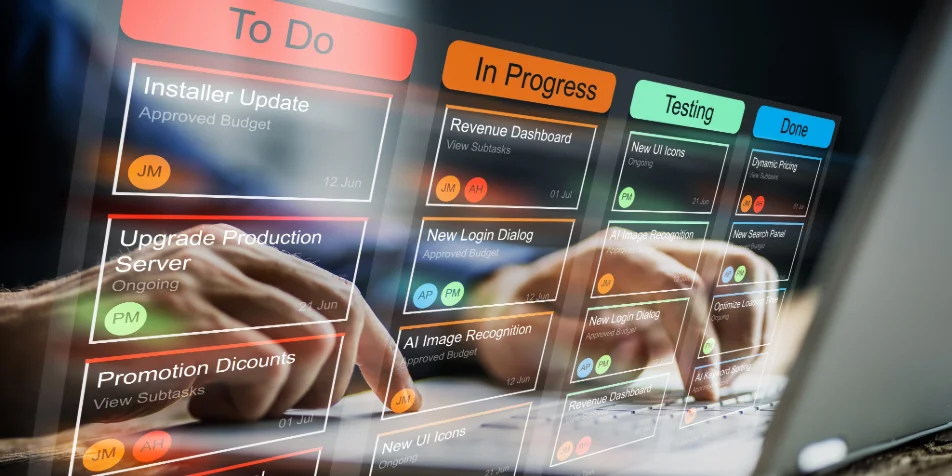
Core Principles of Scrum
Scrum draws its foundations from the Agile Software Development Manifesto; integrating core values and principles into the business culture is critical for the effective implementation of this framework. Scrum is built on empiricism, where knowledge comes from experience and decisions are based on observation; this structure rests on the three pillars of transparency, inspection, and adaptation. According to the principle of transparency, the work performed, progress status, and problems must be visible to everyone. The visibility of Backlogs, clarity of the sprint goal, and specific work definitions are based on this principle. The inspection principle underlines the regular checking of products and processes. Sprint reviews and daily Scrums are examples of these inspection mechanisms. Adaptation refers to the rapid correction of deviations or process bottlenecks identified during the inspection phase; Sprint Retrospective meetings are the most vital mechanism of this continuous improvement cycle.
The 5 Core Values of Scrum
According to the official Scrum Guide, the success of the framework depends on the team's internalization of five values: commitment, focus, openness, respect, and courage. Commitment signifies the team taking responsibility to achieve sprint goals. Focus emphasizes the team concentrating only on the set goals throughout the sprint. Openness refers to clearly sharing progress, problems, and challenges. Respect underlines team members valuing each other's expertise and contribution. Finally, courage involves showing the bravery to make tough decisions, voice problems, and embrace change.
A Structural Approach to Agile Software Development
When Agile software development is mentioned, concepts such as "flexible," "fast," and "open to change" often come to mind first. However, agility does not mean a lack of planning; on the contrary, it offers a highly structural and disciplined framework when applied correctly. At the heart of this structure lies the Agile Manifesto, published in 2001. Instead of traditional project management based on rigid and long-term plans, the manifesto advocates an approach that adapts quickly to change, maintains constant communication with the customer, and centers on working software. Scrum, one of the best-known applications of the Agile approach, clearly demonstrates the structural side of agility. Responsibilities are clearly defined within the Scrum structure; the Scrum team consists of three fundamental roles: the Product Owner, the Scrum Master, and the Developers. The Scrum Master is a leader (servant leader) who removes impediments in front of the team and guides them through Scrum theory and practices. The Product Owner is responsible for maximizing the value of the product and prioritizes the Product Backlog according to strategic business goals. Developers are responsible for delivering a usable product Increment that meets the "Definition of Done" at the end of each Sprint. In Scrum, sprint durations are fixed and daily meetings are regular. A functional product piece emerges at the end of every sprint. Thus, agile methods provide a framework while also offering freedom.
Kanban vs. Scrum
The comparison of Kanban vs. Scrum is frequently made. Kanban and Scrum are the two most widely used methods within agile approaches. Both are based on principles of flexibility, transparency, and continuous improvement; however, their working styles and levels of structure differ. The features of Scrum vs. Kanban can be compared as follows:
| Criterion | Scrum | Kanban |
|---|---|---|
| Work Structure | Sprints (1–4 weeks) | Continuous flow |
| Time-boxing | Yes (time-boxed) | No |
| Roles | Product Owner, Scrum Master, Developer Team | No mandatory roles |
| Planning | Planning is done at the beginning of the Sprint | Continuous prioritization |
| Change | Changes are not recommended during a Sprint | Can be changed at any time |
| Delivery | At the end of the Sprint | As work is completed |
Agile vs. Scrum
Although Agile and Scrum are often used interchangeably, they are not the same thing. Agile is a philosophy and a set of principles, whereas Scrum is a framework used to implement Agile. Agile is a mindset that focuses on rapid adaptation to change, customer collaboration, and working software. Scrum is a structured system created to bring Agile principles to life.
Click to learn what DevOps is and how it works! Also, do not forget to examine GlassHouse DevOps services!