


GPU as a Service - H Series

GPU infrastructure hosted in Turkey, delivered from a highly available and KVKK-compliant cloud platform, purpose-built for your AI and high-performance computing workloads.
Contact us now! ABOUT
ABOUT
Cloud-based GPU resources hosted entirely within Turkey and fully compliant with local regulations.
As GlassHouse Cloud, we deliver a secure, scalable, and truly differentiated technology experience through our GPU as a Service (GPUaaS) platform—hosted entirely in Turkey, fully compliant with KVKK and all sector-specific regulations, and backed by a high-availability architecture.
We reinforce data security with geographically redundant infrastructure and 24/7 monitoring, ensuring full compliance with all KVKK requirements. With GlassHouse Cloud GPU as a Service, you can confidently run AI workloads, large language models (LLMs), computer vision, video rendering, design and product development pipelines, scientific computing, and machine learning operations on NVIDIA’s latest GPU architecture.
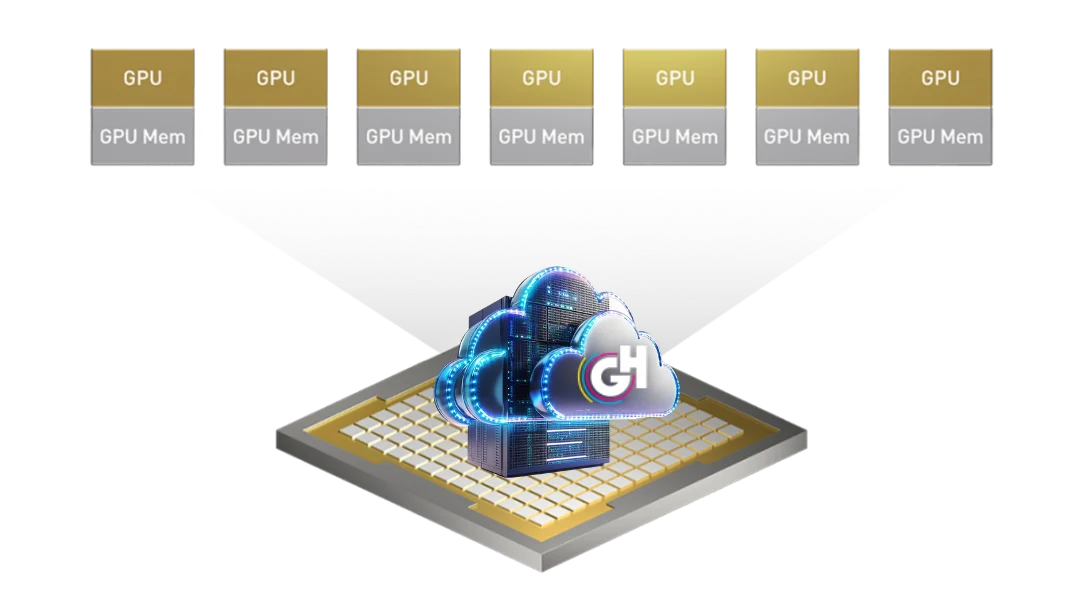
With the GlassHouse Cloud platform and isolated GPU partitioning (MIG), we maximize both performance and security across your operational workflows.
Leave infrastructure management, system maintenance, version updates, and capacity planning to us—focus your time and resources on innovation with GlassHouse Cloud GPU as a Service!
CONTACT FORM
Complete the form to get in touch with us! Let's build the infrastructure of success for your IT operations together.
FEATURES
Discover the features of our GPU as a Service - H Series.

Multi-Instance GPU (MIG) for multi-tenant environments:
By partitioning high-performance NVIDIA GPUs into isolated resource units, the infrastructure delivers maximum efficiency for multiple users and concurrent workloads.

Distributed Model Training:
Parallel and scalable training of models— including multi-stage LLM training—can be performed on NVIDIA’s multi-GPU H100 architecture, enabling efficient processing of large datasets.

LLM (Large Language Model) Training and Inference:
With NVIDIA’s state-of-the-art GPUs, large-scale language models can be trained at high speed and leveraged for real-time inference.

NLP (Natural Language Processing):
Delivers high performance and accuracy for large-scale text analytics, sentiment detection, chatbot development, and document classification workloads.

Agentic AI, recommendation engines, and conversational AI:
Thanks to minimal latency and parallel GPU processing, intelligent recommendation and response systems can be efficiently executed on large-scale datasets.

Computer Vision:
Large-scale image and design processing, video analytics, and synthetic data generation are seamlessly handled by GPUs' high-throughput data processing capabilities, enabling the efficient execution of complex visual and multimedia workloads.

Real-Time Inference and Low-Latency Analytics:
With NVIDIA’s next-generation accelerators, live systems can deliver reliable AI outputs for real-time decision-support applications.

Easy Integration and Access:
GPU resources can be accessed remotely and effortlessly through interfaces such as SSH and APIs.
ADVANTAGES
Unveil the advantages of GlassHouse GPU as a Service - H Series!

NVIDIA GPUs deliver significantly higher speed and performance compared to traditional CPUs, executing complex AI/ML, LLM, Computer Vision, and NLP workloads in seconds through their parallel processing architecture. With MIG (Multi-Instance GPU) technology, GPUs can be segmented into isolated resource units, providing optimized performance for each workload. Thanks to automatic scaling, capacity can be increased or decreased instantly based on project demands—ensuring maximum efficiency across workloads.
Instead of investing in your own GPU hardware, you can avoid high CAPEX costs as well as ongoing maintenance and management expenses by leveraging cloud-based GPU resources. GlassHouse handles all specialized operational processes—including hardware management, updates, cooling, energy optimization, and capacity planning—while your IT teams focus on strategic initiatives and innovation. With a pay-as-you-go model, you can maximize budget efficiency.
Operate seamlessly with a geographically redundant, 24/7 accessible infrastructure. Cloud-based GPU resources ensure continuous uptime through automated failover and high-availability architectures, safeguarding the resilience of your systems.
GlassHouse GPUaaS is hosted in data centers within Turkey, fully meeting the requirements of regulation-heavy industries—such as finance and public sector—especially KVKK. Your sensitive and personal data is processed and protected in full compliance, backed by local operational assurance.
Access GPU resources remotely with ease through convenient interfaces such as SSH, APIs, and the cloud console. Achieve rapid workflow adaptation, agility in development processes, and seamless integration across applications.
REFERENCES
We are a member of the teams of Turkey's leading companies!









Blog content that may be of interest to you
What Is a Virtual Machine? Virtual Machine vs. Container
Virtual machines and container technologies are two fundamental approaches that address different needs in modern software and cloud infrastructures. Virtual machines are used in scenarios that require high security, full control, and strong isolation thanks to their isolated architecture, where each virtual machine runs its own operating system. Containers, on the other hand, enable applications to run faster, consume fewer resources, and scale more easily due to their lightweight architecture. Virtual machines are particularly preferred for enterprise systems, test environments, and critical infrastructures. Containers, meanwhile, stand out in microservices architectures, CI/CD pipelines, and modern cloud-native applications. Therefore, the choice depends on striking the right balance between security and isolation requirements and the need for speed and efficiency. Discover all the details in our article.
Read More
Load Balancer: How Does Your System Stay Online During Traffic Surges?
Load balancer systems are critical infrastructure solutions that keep applications running without interruption under heavy traffic conditions. By distributing traffic evenly across servers, they improve performance, provide fault tolerance, and form the foundation of scalable system architectures. In this article, we cover the most important concepts you need to know about load balancer technologies.
Read More
Why Is Monitoring in IT Infrastructure Critical?
In IT infrastructures, monitoring enables the early detection of potential issues by continuously tracking system performance. In this content, we will address what monitoring is, how it works, and why it is critically important. Additionally, we will emphasize how monitoring adds value in terms of business continuity, security, and performance optimization through monitoring tools, in-application analytics, and centralized solutions, while highlighting the advantages it provides to businesses.
Read More
Data Center: What It Is, What It Is Not, and How It Is Built
Data centers, one of the fundamental building blocks of digital transformation, are an indispensable component that provides strategic investment value and competitive advantage for modern enterprises. Data centers form the backbone of an organization’s digital infrastructure and enable the secure, fast, and uninterrupted management of data. Discover more details about data centers in our article!
Read More
What is GPU as a Service H Series?
GPU as a Service H Series is a strategic Infrastructure as a Service (IaaS) solution that enables organizations to access high-performance compute power through the cloud without making physical GPU hardware investments (CapEx). It accelerates model training and data processing by offering a flexible and scalable architecture, especially for projects requiring compute-intensive workloads such as artificial intelligence (AI), machine learning (ML), big data analytics, and high-performance computing (HPC). Further details are available in our article.
Read More
Difference Between Backup as a Service (BaaS) and Disaster Recovery as a Service (DRaaS)
Backup as a Service (BaaS) and Disaster Recovery as a Service (DRaaS) are two different cloud services used for data security and business continuity. While BaaS protects your data by backing it up regularly, DRaaS enables critical systems to be rapidly restored and business continuity to be maintained in line with target recovery times (RTO) in the event of a potential disaster. In this article, you can examine the key differences and features of these two services.
Read More
What Is SIEM?
SIEM is one of the key cybersecurity solutions that enables organizations to collect and analyze security events occurring within their IT infrastructure on a centralized platform and detect potential threats at an early stage. By correlating log data from different systems, SIEM products provide security teams with comprehensive visibility and deliver advantages such as real-time threat detection, rapid incident response, and detailed reporting. Thanks to these capabilities, SIEM solutions are considered one of the fundamental components of modern security operations. In this guide, we examine the technical details of SIEM architecture and its operational working principles.
Read More
What is PostgreSQL? Features and Enterprise Use Cases
PostgreSQL strengthens the data infrastructure of companies as an open-source, scalable, and secure database management system. Thanks to its flexible structure, extensive extension support, and cloud compatibility, it offers high-performance solutions for businesses of all sizes. Find more details about PostgreSQL in this article!
Read More
Frequently Asked Questions About NVIDIA Graphics Cards
Featuring scalable architecture and a wide range of models, NVIDIA graphics cards cater to gamers seeking high performance, content creators, and professionals in data centers. Selecting the right graphics card for both gaming PCs and enterprise IT infrastructures should be based on hardware compatibility, workload requirements, and capacity planning analyses. To simplify your graphics card selection and help optimize your infrastructure investments, we have compiled the answers to the most frequently asked questions in this guide.
Read More
What is MongoDB? Architecture and Performance Advantages
MongoDB is a flexible and scalable NoSQL database developed for high-volume and constantly changing data. By storing data using a document-based logic, it operates faster and more flexibly than traditional relational databases, making it a frequent choice for modern web projects, e-commerce sites, and real-time data processing applications. In this article, you can find information on MongoDB's working structure, advantages, differences from other databases, and use cases.
Read More
What is Node.js and Where is it Used?
In this article, you can learn that Node.js is not a programming language but a JavaScript-based runtime environment, how it works, and why it is frequently preferred in modern application development. We examine in detail Node.js's high-performance non-blocking structure, its role in REST API development processes, and its advantages in real-time applications. Additionally, it is possible to see here how the system is integrated with microservices architectures, cloud infrastructures, and DevOps processes. If you want to develop scalable, fast, and modern web applications, you can find the technical advantages offered by Node.js within a clear framework in this guide.
Read More
The Backbone of Modern IT: Cloud Computing
In this article, we examine how cloud computing has evolved from being just an infrastructure choice to the fundamental operating model of modern IT. We analyze the strategic reasons behind the transition from the traditional data center approach to scalable and flexible cloud architectures, explaining the roles of microservices architecture, container technologies, and DevOps integration in this transformation. Critical topics such as high availability, disaster recovery, auto-scaling, and hybrid cloud strategies are also covered. Start reading now to see the concrete benefits cloud computing provides to organizations through various use cases, from AI projects to SaaS applications!
Read More
What is JavaScript, What Does JS Do?
JavaScript, the most popular programming language, enables the development of interactive and dynamic web pages. Details regarding JS, which can perform clicking, filtering, searching, form validation, animation, and data operations, are in this article!
Read More
What is a VPC (Virtual Private Cloud)?
VPC (Virtual Private Cloud) offers a secure and controllable network environment dedicated to you, even though it runs on public cloud infrastructure. Thanks to network isolation, private IP addresses, and advanced security rules, you can clearly manage who can access your systems. Its ability to scale easily according to need makes VPC advantageous for growing projects. Start reading now for all the details!
Read More
What is SMTP, What Does It Do, How Does It Work?
In this article, you will find what SMTP is, how it works in the email sending process, and how it differs from POP3 and IMAP. Additionally, comprehensive information about the ports used by SMTP, Gmail SMTP settings, commonly encountered SMTP errors, and the role of cloud-based SMTP systems in modern email infrastructures is included here. Start reading now!
Read More
What is Virtualization? What Are the Types of Virtualization?
Virtualization is a technology that enables businesses to utilize physical IT resources more efficiently and flexibly through software. By creating multiple virtual servers, applications, or working environments on a single piece of hardware, costs are reduced, and resource usage is optimized. Thanks to virtualization, systems are managed more easily, scalability is increased, and business continuity is secured. With all these aspects, virtualization is a strategic infrastructure component for modern businesses. More details about virtualization are in this article!
Read More
What Is a VPS? About VPS Types and Usage
In this content, we examined the VPS concept from every angle and shared its use cases, advantages, and how it differs from other server solutions. Identifying the right VPS type for your project can be an important step in terms of performance and resource management. With the right configuration, VPS solutions provide a flexible and sustainable infrastructure. All the details are in our article—start reading now!
Read More
What Is Cloud Storage, How Does It Work, and What Are Its Types?
In this content, we have compiled the core operating principles of cloud storage, its storage types, and the advantages it offers. By reading the article, you can see how cloud storage solutions simplify data management processes for both individual use and corporate environments. When the right solution is selected, cloud storage provides a secure and sustainable infrastructure. Start reading now for all the details!
Read More
Server and Data Center Infrastructure Solutions
Dell Technologies data center infrastructure solutions deliver an end-to-end enterprise portfolio encompassing servers, storage, hyper-converged infrastructure, and data protection components. They provide high performance, security, and scalability for diverse workloads. Discover detailed insights into Dell Technologies server solutions in this article!
Read More
What Are Data Storage and Data Protection Solutions?
In this content, we take a holistic look at data storage and data protection solutions that address organizations’ growing data volumes and security requirements. By leveraging solutions designed for different workloads, scales, and use cases, you can explore how to store, manage, and—when needed—quickly restore your data securely. Start reading now to learn which solution best fits which need based on critical criteria such as performance, scalability, cost optimization, and cyber resilience.
Read More
What Is a CDN?
A CDN is a network of servers that delivers the static and dynamic content of websites to users quickly and securely through servers distributed across different geographic locations. By serving content from the server closest to the user, it improves page load times, reduces server load, and ensures uninterrupted site performance during high-traffic periods. You can find more details about CDN (Content Delivery Network) in our article!
Read More
What Is Localhost and How Is It Accessed?
Localhost is a server environment running directly on your computer, enabling you to perform processes such as web development, software testing, and database management securely and efficiently. You can test your projects without requiring an internet connection, quickly detect errors, and conduct performance checks. In business workflows, localhost shortens development time, ensures testing is done in a secure environment, and reduces costs. This allows organizations to execute their digital projects more efficiently and with greater control. Continue reading for more details!
Read More
What is an NVIDIA GPU? NVIDIA GPU Guide
NVIDIA is a leading technology company that manufactures powerful GPUs used in areas such as gaming, artificial intelligence, 3D modeling, and data processing. A GPU (Graphics Processing Unit) is a specialized processor designed to handle graphics and compute operations in parallel. NVIDIA GPUs are widely used for gaming, 3D rendering, video editing, AI workloads, and data science applications. The most common product families include GeForce (gaming), RTX Studio / Professional (professional design and workstations), the A Series and H100 (AI and HPC), Tesla (legacy), and NVIDIA DRIVE (autonomous driving). GPUs process data in parallel to compute lighting, shadows, textures, and effects in real time, while CUDA and Tensor Cores accelerate artificial intelligence workloads. The best GPU option depends on the intended use: GeForce for gaming, RTX Studio for 3D/animation, A Series and H100 for AI, and NVIDIA DRIVE for autonomous vehicles. Additionally, NVIDIA stands out with its AI software ecosystems and data center solutions, whereas AMD focuses on price-performance balance with its ROCm platform. Using NVIDIA GPUs in the cloud reduces hardware costs, provides scalability, delivers high performance, and enables remote access. In short, NVIDIA GPUs have become a critical hardware component for both individuals and enterprises by maximizing both graphics and compute performance in modern computing and data center environments. Start reading now to learn more!
Read More
What is a Database Administrator (DBA)? Roles & Competencies
A Database Administrator (DBA) is a specialized professional responsible for managing corporate databases securely, efficiently, and without errors. They perform critical tasks such as database installation, performance optimization, backup, and access control. By ensuring data integrity and security across corporate operations, they directly contribute to informed strategic decision-making. Discover more about the responsibilities of database administrators here!
Read More
What Is DNS Switching? Best Methods for Secure Access
DNS is one of the fundamental building blocks of the digital world, ensuring correct routing of internet traffic. However, misconfigured or weak DNS infrastructures may expose organizations to risks such as data breaches and access issues. In this article, we explore the concept of DNS switching from both a technical and security perspective!
Read More
What is a Cloud Server?
We’ve gathered everything you need to know about cloud servers. If you’re wondering what a cloud server is, why it matters, and what advantages it offers, all the details are covered in this article!
Read More
Which Cloud Model Is Best for Your Business? Public, Private, and Hybrid Cloud
Unsure which cloud solution is best for your business? In this article, we compare public, private, and hybrid cloud models to help you find the answers you're looking for.
Read More
What Is Hybrid Cloud?
We’ve answered all your questions about hybrid cloud solutions. In this article, you’ll find everything about how the hybrid cloud model works, its advantages, which businesses can benefit from it, and more.
Read More
What Is Hosting?
Looking for the answer to "What is hosting?" Visit the GlassHouse Blog! Discover hosting security, types of hosting, and much more.
Read More
What is Public Cloud? Key Benefits for Businesses
Explore the fundamentals of public cloud and discover its strategic advantages for businesses in the GlassHouse Blog!
Read More
What Is Redis and How Does It Work?
Redis, a high-performance, in-memory, open-source data store, operates on a key-value structure while supporting various data types such as lists, sets, sorted sets, and hashes, distinguishing it from traditional databases. Thanks to its lightweight and independent architecture, this program can be easily installed and operated on different operating systems and is used in scenarios such as real-time data processing, caching, and messaging. Prominent use cases include leaderboards, publish/subscribe messaging, task queues, Full Page Cache (FPC), and real-time analytics. Redis is known for its simplicity and ability to provide fast data access through its key-value relationship. When combined with cloud systems, Redis allows data to be stored and managed securely and accessed from anywhere. In summary, Redis is both a fast and flexible data management tool, making it an ideal solution for modern software and cloud-based applications. Read on to discover more details!
Read More
What Is Application Performance Monitoring (APM)?
Application Performance Monitoring enables real-time monitoring of the speed, stability, and availability of applications. In doing so, it allows early detection of performance issues, improves user experience, increases operational efficiency, and helps deliver uninterrupted service. For businesses, APM is not only a technical tool but also a strategic investment that prevents revenue loss and provides a competitive advantage. You’ll find more details about APM systems in our article!
Read More
What is LAN (Local Area Network)? What Are Its Types?
Local Area Networks (LAN) are one of the fundamental network solutions that enable devices to connect with each other within limited areas. Offering the advantages of high-speed data transfer, low latency, and secure communication, LAN connections are used in offices, homes, schools, and small businesses either wired or wireless, while other network types such as WAN, VLAN, WLAN, and MAN are chosen based on different needs. Additionally, the integration of LAN with cloud systems enhances corporate efficiency by providing benefits such as data synchronization, backup, and remote access. Here are all the details compiled in our article!
Read More
What is a Gateway and What Does It Do?
A gateway is a critical network component that acts as a bridge between different networks and enables data communication. Widely used across many areas, gateways ensure seamless communication between networks with different protocols. They provide essential functions such as data transmission, protocol translation, routing, and address translation (NAT). You can find all the details about gateways in our article.
Read More
What is Docker and What is it Used For?
Docker is an open-source container platform that has fundamentally transformed software development processes. This technology ensures that applications run consistently across different environments and has been used by millions of developers since 2013. It simplifies the processes of developing, testing, and deploying applications. All the details about this technology can be found in our article.
Read More
What is a Database?
In this article, we cover everything you need to know about databases—digital systems where critical information and data are stored in an organized, secure, and accessible manner! If you want to explore the different types of databases and their operating principles that can benefit organizations and businesses, start reading now.
Read More
What is SQL (Structured Query Language)?
SQL is a standard query language used to communicate with and manage databases. By facilitating operations such as adding, updating, deleting, and querying data, it provides businesses with organized and accessible information. This accelerates decision-making processes and enhances efficiency. SQL plays a critical role across a wide spectrum, from small-scale projects to large enterprise systems. You can find more details about SQL in our article.
Read More
What is a Proxy and What is it Used For?
A proxy is an intermediary server between the internet and the user that hides your IP address, ensuring identity security and helping you bypass access restrictions. Different types offer various functionalities such as filtering, caching, anonymity, or high-level privacy. For example, a smart proxy analyzes traffic to select the fastest and most secure route, while a blockaway proxy primarily provides access to restricted content. Proxy settings can be configured based on the device and operating system. In addition, in cloud systems, proxy servers are used for data security, access control, and traffic optimization. This article covers in detail what a proxy is, how it works, and for what purposes it is used. Enjoy reading!
Read More
What is Migration? How to Perform Data Center Migration?
Migration, the process of moving an application, data source, or system from its current location to another environment, consists of the following steps: requirements analysis and planning, preparation of source and target environments, data mapping and transformation, data transfer, validation and testing, go-live, and monitoring. Each step in the process is critical for data security and system continuity. Before performing database migration—which is required when there is a need for system changes, performance improvements, or expanded data storage—precautions such as data backup, testing in a staging environment, and version control must be taken to minimize data loss. By continuing to read, you can find detailed answers to questions such as how to perform migration using Goose for Golang, SQL commands for SQL-based systems, or Gorm for ORM-based processes, as well as what data center migration entails.
Read More
What is DevOps and How Does It Work?
DevOps is a culture and methodology that brings together software development and operations teams. Through processes such as continuous integration, continuous delivery, automation, and monitoring, it accelerates the software development lifecycle. It enables businesses to achieve faster time-to-market, fewer errors, and higher customer satisfaction. Learn more about DevOps in our article!
Read More
What is DSL? What Are Its Types?
DSL (Digital Subscriber Line) is a connection technology that provides high-speed internet access over existing telephone lines. With its different types such as ADSL, VDSL, SDSL, and G.SHDSL, DSL offers speed, performance, and cost advantages depending on user needs and distance. For example, ADSL provides a cost-effective and asymmetric solution for home users, while VDSL delivers high speed and performance over short distances. SDSL, on the other hand, offers symmetric connections, making it an ideal choice for businesses and data-intensive users. Continue reading to explore the definition of DSL, its types, working principles, its relationship with cloud services, and answers to the most frequently asked questions on this topic.
Read More
What Is an Operating System?
An operating system is the core software that manages the hardware resources of computers and mobile devices while acting as a bridge between the user and the hardware. In this article, computer, dedicated, and gaming console operating systems are covered in detail. You can also explore comprehensive information about Turkey-originated local operating systems such as Pardus, Milis Linux, Archman Linux, Pisi Linux, and Turkix. In short, this content provides answers to frequently asked questions such as what an operating system is, how it works, its types, and how it is managed, along with additional insights on the most common queries on the topic.
Read More
What Is VDS and How Does It Work?
In the VDS model, created by partitioning a physical server into independent segments using virtualization technology, each user is allocated dedicated CPU, RAM, and storage resources. This ensures top-level performance and security. Compared to shared hosting, this server type offers greater security and higher performance, while providing a more cost-effective solution compared to dedicated servers. The setup process includes selecting the appropriate package, installing the operating system, performing basic configurations, and applying security settings. With VDS, users gain the freedom to run websites, e-commerce projects, game servers, database management, software hosting, VPN, and backup operations across multiple use cases. For detailed information on VDS’s working principles, setup steps, and use cases, read the full article.
Read More
What is HTTP? What is HTTPS? What Are the Differences?
While HTTP is a fundamental internet protocol that enables data transmission between the client and the server, HTTPS secures this communication by encrypting it with SSL/TLS certificates. HTTP offers faster and simpler communication; however, HTTPS ensures the security and integrity of user data. Therefore, HTTPS is critically important, especially for e-commerce, banking, and membership systems that handle sensitive data. Moreover, it is worth mentioning that HTTPS also has a positive impact on SEO performance. For detailed information about HTTP and HTTPS protocols—such as installing SSL certificates, updating site links, correctly configuring 301 redirects, using HTTPS in cloud services, and the benefits it provides—you can read the full article.
Read More
What is Kubernetes and What is it Used For?
Kubernetes is an open-source platform that simplifies the management of containerized applications; it automates scaling, updating, and ensuring the uninterrupted operation of applications, providing businesses with cost efficiency and flexibility. Learn more about Kubernetes in this article!
Read More
What is an Application Programming Interface (API) and How is it Used?
Here are the key details about APIs, which act as a bridge enabling different applications and software to communicate with each other!
Read More
What is the OSI Model? OSI Layers and Their Functions
Discover all the details about the OSI model, a 7-layer framework that standardizes how devices and software communicate over computer networks.
Read More
What is a Log? Why Logging Matters for Businesses
This article covers everything you need to know about log recording, which is crucial for businesses in terms of security monitoring, breach detection, regulatory compliance, and performance optimization.
Read More
What is HCI (Hyper Converged Infrastructure)?
Hyper-Converged Infrastructure (HCI) stands out as a modern technology that consolidates the compute, storage, and networking components of traditional data center systems into a single, software-defined platform. In this article, we provide comprehensive answers to questions such as “What is HCI?” “Where is it used?” and “How does it differ from traditional infrastructure?”, while also examining HCI’s relationship with cloud systems and on-premises solutions, its use cases, and the operational efficiencies it delivers. In addition, the article explores why organizations are transitioning to HCI, the contributions of this technology to business continuity, cost efficiency, and scalability, as well as insights into the product portfolio offered through the GlassHouse and Dell Technologies partnership.
Read More
What is DHCP?
DHCP is a vital protocol that automatically assigns IP addresses and other network settings to devices on a network. In this article, we dive into the core questions like “What is DHCP?”, “How does it work?”, and “How are IP addresses assigned?”. We also explore potential issues that can arise if DHCP is disabled, security measures like DHCP snooping, and the benefits of managing DHCP in cloud-based environments. Happy reading!
Read More
What is SaaS? Features of Software as a Service
This article addresses all your questions about SaaS applications, which refer to the delivery of software over the internet as a service.
Read More
What Is Cloud Computing and What Are Its Key Features?
You don’t need to make large hardware investments to build your IT infrastructure. Cloud computing technologies offer agile solutions to your business needs with flexible usage models and low total cost of ownership. So, why should you choose the cloud when modernizing your infrastructure? Start reading now to find out!
Read More
What Does Server Mean?
The term “server” refers to a central system in the digital realm that delivers data and services to users. Its operating principle is founded upon processing client requests and delivering appropriate responses. Physical, virtual, and cloud servers each offer benefits tailored to different needs, while correct selection and management directly influence performance and security. Additionally, being familiar with common server errors and terminology can enable quicker responses in system administration. Continue reading our article for more.
Read More
What is DNS?
What is DNS? Common Errors, Security Risks, and Cloud-Based DNS Management
Read More
What Is Object Storage as a Service (OBSaaS)?
Object Storage as a Service enables secure, scalable storage of unstructured data tailored to modern needs—with advanced features like replication, continuous monitoring, multi-location backup, and secure VPN access. Our article also clearly explains the differences between object storage, block storage, and file storage. Start reading now!
Read More
What is Vulnerability Management as a Service (VMaaS)?
Vulnerability Management as a Service (VMaaS) is a comprehensive solution that enables businesses to manage vulnerabilities from a centralized platform with expert support. Through continuous system scanning, risk prioritization, and detailed reporting, it ensures early detection and swift remediation of vulnerabilities. It also helps mitigate critical threats such as zero-day attacks and reduces operational burden while optimizing resource usage. All the details about this service are in our blog post.
Read More
Secure Your IT Infrastructure with Disaster Recovery
With the digitalization of business processes and the increasing reliance on electronic systems, disaster recovery services have become indispensable. Protecting and recovering IT infrastructure, especially in critical business processes, enables companies or organizations to maintain their operations and services more effectively and efficiently. Therefore, disaster recovery plays a crucial role in preventing data loss, ensuring the sustainability and security of technological infrastructure. What is Disaster Recovery? Why is it Important for Businesses and Institutions? Let's delve into the details.
Read More
What is Disaster Recovery as a Service (DRaaS)?
To learn more about Disaster Recovery as a Service (DRaaS)—a solution designed to help businesses protect their data and ensure continuity during unexpected events—simply continue reading. What qualifies as a disaster for businesses? When and how do recovery strategies work? You’ll find the answers in our article.
Read More
What is Container as a Service (CaaS)?
Explore our article to learn everything about CaaS services, which offer pre-configured IT infrastructure for fast deployment while reducing DevOps costs.</
Read More
Types of Hosting: A Comparison of Shared, VPS, Dedicated, and Cloud Hosting
We've compared various types of hosting services with different functionalities just for you! Be sure to check out our hosting comparison table before choosing your hosting solution!
Read More
What Is IaaS (Infrastructure as a Service)?
Infrastructure as a Service (IaaS), a cloud service model that delivers physical infrastructure components in a virtual environment, enables companies to easily scale resources, optimize costs, rapidly deploy infrastructure, and back up data—all while reducing the operational burden on IT teams. Discover all the essential details in our article.
Read More
Emerging Trends in Data Center Infrastructure
We've compiled the upcoming trends and innovations in data center infrastructure for the coming years! In an increasingly digital business world, explore the latest data center trends to stay ahead of the competition.
Read MoreFrequently Asked Questions
A GPU (Graphics Processing Unit) is a specialized processor designed to execute graphic and complex computational tasks through parallel processing. In Artificial Intelligence (AI) and Machine Learning (ML) projects, GPUs deliver significantly higher speed and performance compared to CPUs. Specifically, for Large Language Models (LLM), they accelerate projects by executing massive mathematical functions—such as matrix multiplications—in seconds through their parallel processing capabilities.
GlassHouse GPU as a Service (GPUaaS) is a high-availability, KVKK-compliant cloud GPU infrastructure hosted entirely within data centers in Turkey. It provides enterprises with access to the latest NVIDIA H100 architecture via a OPEX model, eliminating the need for heavy initial hardware investment (CAPEX).
The NVIDIA H100 is built on the next-generation Hopper architecture and delivers 2x to 7x faster performance compared to the previous-generation A100. With its 80 GB HBM3 (High Bandwidth Memory) capacity, it prevents bottlenecks by processing massive datasets at terabytes-per-second speeds, providing unparalleled power for LLM training and inference.
MIG (Multi-Instance GPU) is a technology that allows a single physical NVIDIA H100 GPU to be partitioned into 7 independent instances isolated at the hardware level. Unlike time-shared vGPU solutions, MIG assigns fully dedicated and isolated resources to each workload, eliminating the "noisy neighbor" problem and offering guaranteed performance.
VRAM (Video RAM) is the GPU’s fast, dedicated memory used to store data for instantaneous parallel calculations. The larger the LLM (in terms of parameter count), the more VRAM it requires. If VRAM is insufficient, the model either fails to run or reverts to the much slower system RAM, resulting in significant performance loss.
Model Training: Refers to the "post-production" process of training a model for weeks using billions of data points, requiring the highest computational power.
Inference: The real-time generation of instantaneous responses from trained models (e.g., ChatGPT-like chatbots), where low latency is critical. GlassHouse GPUaaS offers a scalable, high-performance infrastructure for both workload types.
Yes. The entire GlassHouse GPU as a Service infrastructure is hosted in Tier III data centers located within Turkey.
The Managed GPU service provided by Glasshouse goes beyond providing simple hardware access, offering end-to-end support that encompasses all operational and technical layers of the GPU ecosystem. According to the service framework, the core technical details are as follows:
GPU Ecosystem and Component Management
The most critical part of the managed service is the management of the software layers required for the GPU to operate efficiently.
Software Stack Installation and Patching: Installation, management, and updating of core GPU ecosystem components such as CUDA, NVIDIA Container, and Docker are carried out by Glasshouse experts.
Periodic Updates (Patch Management): Patches for the Operating System, GPU hardware, and driver requirements are applied regularly in 3-month cycles in coordination with the customer.
NVIDIA Compatibility: OS updates supported by NVIDIA or the GPU manufacturer are continuously monitored and integrated into the system.
Operating System (OS) and Infrastructure Management
The Managed GPU service also covers the operating system layer running on the hardware (Managed OS).
Installation and Configuration: This includes the installation of the OS, performing baseline configurations, and installing specialized drivers according to customer requirements.
File System and Disk Management: Directory management, intervention in file system failures, and monitoring of disk utilization rates are provided.
Access and Security: Access controls on the server, fulfillment of requests regarding security vulnerabilities, and meticulous tracking of system logs are maintained.
24/7 Monitoring and Operational Intervention
The service is supported by advanced monitoring mechanisms to guarantee business continuity.
Advanced Monitoring: Beyond standard infrastructure, specific metrics such as GPU VRAM utilization and Power State are monitored 24/7.
Incident Management: In case of access disruptions or server/network issues, immediate intervention is provided in accordance with defined Service Level Agreements (SLAs).
Service Ownership: A "service ownership matrix" is created by identifying the services running on the server to ensure all operational gaps are closed.
Strategic Advantages
This technical scope provides enterprises with the fundamental benefit of "focusing on innovation by eliminating operational burden." Instead of dealing with CUDA version incompatibilities or driver errors in complex LLM (Large Language Models) and AI projects, organizations can accelerate their initiatives by leveraging Glasshouse's ITIL-standard management model.
A GPU alone is not a complete solution; the data feeding layers (CPU, RAM, storage, and network) must be powerful enough to support it. If the dataset originates from slow storage, the H100—capable of processing terabytes per second—will remain "idle," extending project timelines. GlassHouse provides high-performance NVMe SSD storage and 100 Gbps network infrastructure to prevent these bottlenecks.
In LLMs, the total model size and the number of active parameters used in a specific calculation can differ. Architectures like MoE allow for more optimized VRAM usage, enabling massive models (e.g., those occupying 800 GB of disk space) to run with appropriate VRAM configurations.
RAG structures working on corporate document sets or Agentic AI systems providing intelligent responses can produce high-accuracy results with low latency without requiring massive VRAM capacities. These methods reduce costs by utilizing GPU parallel processing power most efficiently.
Purchasing GPUs requires high CAPEX (Capital Expenditure). With GlassHouse’s model, enterprises manage these costs as OPEX (Operational Expenditure). This eliminates hidden costs such as hardware depreciation, energy, cooling, and maintenance, allowing budgets to be redirected toward innovation.
No. Thanks to the 4th Gen NVLink technology in the NVIDIA H100, up to 8 GPUs can be interconnected with a massive bandwidth of 900 GB/s. This "Distributed Model Training" capability ensures linear scaling without performance loss during LLM training with large datasets.
Our service is designed for all sectors requiring high-volume Natural Language Processing (NLP), large-scale Computer Vision, Deep Learning, and Big Data Analytics. It is widely used in industries where data security is critical, such as banking, payment systems, and healthcare.
GlassHouse infrastructure is geographically redundant and monitored 24/7. In the event of a hardware failure, workloads are automatically transferred to healthy GPU resources through N+1 redundancy structures or Kubernetes orchestration, minimizing operational downtime.
Yes. GlassHouse GPUaaS infrastructure is hosted entirely in data centers within Turkey. This physical locality fully meets the "data residency" and "isolated hosting" requirements of regulators such as BDDK (Banking Regulation and Supervision Agency) and SPK (Capital Markets Board).
A powerful GPU will remain "idle" and wait if supported by slow storage. To prevent such bottlenecks, GlassHouse supports its GPU units with high-performance NVMe SSD areas and 100 Gbps low-latency network switches, ensuring that data feeding speeds are synchronized with the GPU's processing power.