





What Is MLOps?
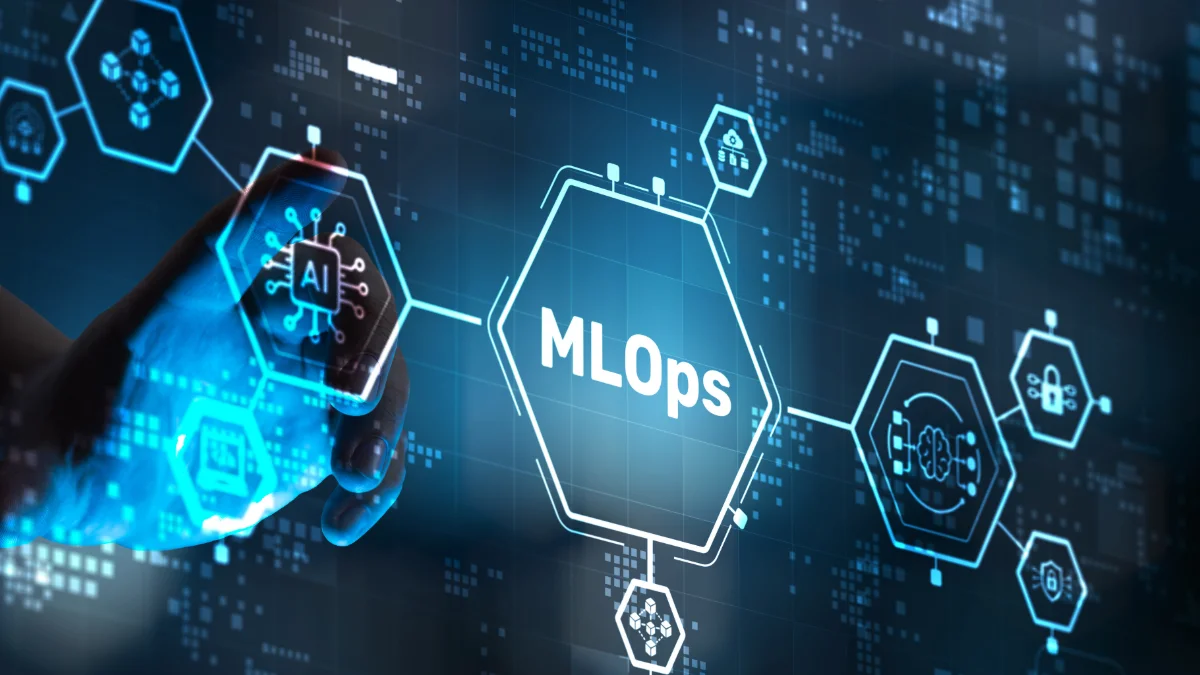
Offering numerous benefits such as process automation, scalability, data accuracy, reliability, and seamless workflows, MLOps stands out as a process that provides companies and organizations with a wide range of advantages. Enabling machine learning models to be deployed to production environments in a reliable and sustainable manner, MLOps is essentially an approach that brings together data science, machine learning engineering, data engineering, and DevOps practices. By continuing to read, you can find answers to questions such as what is MLOps, how does it work, what advantages does it offer, what are its components, and how does it differ from DevOps processes.
MLOps, an abbreviation for Machine Learning Operations, encompasses the entire machine learning lifecycle, from defining business objectives and preparing data to developing and validating the model, deploying it to the production environment, monitoring it, and retraining it when necessary. Throughout this process, multiple teams work together. Data engineers who acquire the data, data scientists who prepare the data and develop the model, and operations specialists who support the model work collaboratively to bring multiple processes together. By productizing machine learning, one of the major challenges of the modern era, businesses can transform the insights they discover in their fields of operation into tangible value for their organizations.
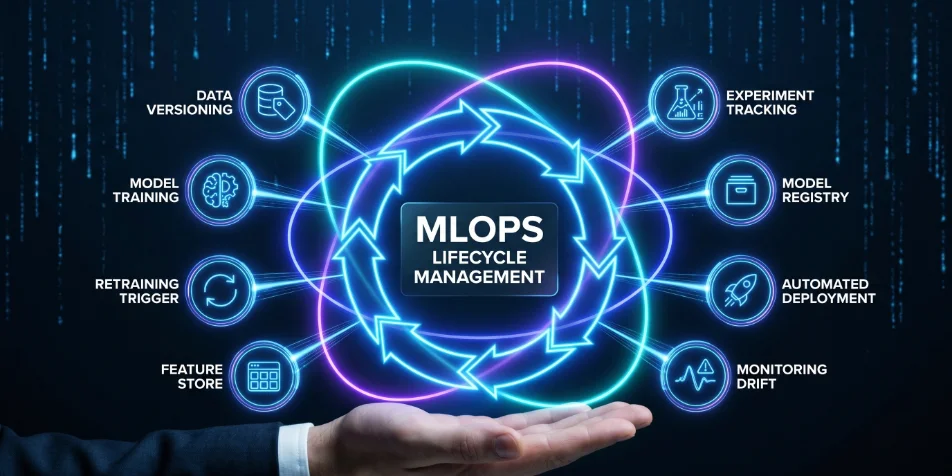
MLOps Components
You can see the MLOps components that make up machine learning operations under the headings below.
- Data Preparation: The data required throughout the process is collected, cleaned, and processed in this first step. The features to be used in model training are created, transformed, validated, and managed in a reusable format at this stage.
- Automated Pipelines (ML Pipelines): In the second stage, known as ML Pipelines, pipelines are created to automate steps such as data preparation, model training, testing, validation, and deployment. This reduces manual intervention, minimizes human error, and enables processes to be carried out more quickly and consistently.
- Version Control: All changes made to the model, dataset, and code are recorded. This allows you to revert to previous versions whenever necessary, compare different model versions, and facilitate collaboration within teams.
- Continuous Integration, Delivery, and Training (CI/CD/CT): Within CI, changes made to code, data, and pipeline components are tested. CD enables validated models and pipelines to be delivered securely to target environments, while CT enables the model to be retrained with new data when predefined conditions are met.
- Model Monitoring and Feedback: In the final stage, the accuracy, performance, latency, and data drift of the model deployed to production are regularly monitored. Based on the feedback obtained, the model is retrained when necessary to ensure sustainable performance.
You may also be interested in our article titled Everything You Need to Know About CI/CD Processes.
How MLOps Works
As briefly mentioned above, MLOps consists of a process that encompasses the development, testing, deployment, and monitoring of machine learning models. You can find detailed information about the core MLOps lifecycle under the headings below.
Data Preparation, Model Development, and Monitoring
As you might expect, the MLOps process differs from traditional software development. Incorporating data management into its structure, the MLOps operating model is based on three fundamental stages in practice. The first stage is data preparation, during which data is collected, cleaned, subjected to feature engineering, and divided into test sets. The algorithms to be used are then determined, and the model is trained accordingly. At this stage, hyperparameter optimization is performed and performance metrics are validated. The final stage, deployment and monitoring, involves deploying the completed model to the production environment and generating real-time predictions with it.
Automation Cycle
At the very heart of the MLOps process are the cycles that enable automation. You can find all the details about these cycles below.
- Continuous Integration (CI): When changes are made to model code or pipeline components, the CI process automatically runs code tests, data and schema validations, component tests, and, when necessary, checks related to model training.
- Continuous Delivery (CD): This involves packaging the model that has passed testing and validation and preparing it for deployment to the target environment. Depending on the organization's processes, deployment to production can be performed automatically or subject to approval.
- Continuous Training (CT): This stage is one of the most important aspects that distinguishes MLOps from DevOps. Model performance may decline over time due to changing user behavior and environmental factors. Through the continuous training cycle, the model can be updated using new data when a decline in performance is detected or whenever deemed necessary.
Model Monitoring and Management
The model deployed to production is continuously monitored. Any errors or deviations that may occur in its predictions are tracked by the system. When necessary, the model can even be rolled back to its most stable version. In short, this stage involves recording all stages of the model lifecycle.
Advantages of MLOps for Companies
Offering numerous benefits, from increased operational efficiency and speed to automation, scalability, traceability, team collaboration, and early error detection, MLOps makes it possible to eliminate manual processes and minimize human error. You can see the most common advantages of MLOps below.
- Automation: With MLOps, repetitive processes reduce manual workloads and enable automation.
- Operational Efficiency and Speed: As processes become automated and manual workloads decrease, teams can work more efficiently and project outputs can be delivered much faster.
- Scalability: The model adapts to increasing data volumes, enabling processes to scale easily.
- Traceability: It also provides the ability to track all changes made to the model, data, and code. This makes the entire process transparent and traceable.
- Early Error Detection: Through continuous monitoring, potential performance degradation and errors in the model can be detected at an early stage.
- Resource Efficiency: For all these reasons, MLOps processes enable the most efficient use of time, human resources, and infrastructure resources.
What Are the Differences Between MLOps and DevOps?
The table below shows the differences between MLOps and DevOps.
| Criterion | MLOps | DevOps |
|---|---|---|
| Focus | Development, deployment, and management of machine learning models. | Development, testing, and deployment of software applications. |
| Core Components | Data, machine learning models, and algorithms. | Application code and software infrastructure. |
| Process | Includes data preparation, model training, validation, deployment, and model monitoring. | Includes code development, testing, integration, deployment, and maintenance processes. |
| Reason for Updates | New data, model performance degradation, or data drift. | New feature additions, bug fixes, or security updates. |
| Success Metrics | Model accuracy, prediction performance, and data quality. | Application stability, deployment speed, and system performance. |